If you ask individuals why they haven't taken a first aid course yet, the solutions normally split along acquainted lines. Some state they can't spare a full day at a training facility. Others doubt that on the internet modules can instruct them exactly how to deal with a choking young child or a colleague in cardiac arrest. I have actually taught both styles for years, from silent Monday-night CPR training sessions to high-intensity weekend workshops, and the truth is much more nuanced than a straightforward thumbs up or down. The very best selection relies on your goals, your danger account at work or home, and just how you discover under pressure.
This guide lays out what online and in-person alternatives each succeed, where they fail, and how to match the layout to your needs. I will certainly reference usual elements of a first aid and CPR course, how certification works, and what to expect from a CPR correspondence course. The objective is to assist you select training that actually sticks, not simply a certificate that ends in your wallet.
What first aid training truly covers
People picture bandages and rescue alarms. In method, a conventional first aid and CPR course educates acknowledgment, prioritization, and a series of easy actions that purchase time until professionals show up. The ability periods prevention, assessment, and hands-on treatments. A versatile first aid course normally includes:
- Scene safety and security, key study, and asking for help CPR for adults, usually with alternatives for youngsters and infants Automated exterior defibrillator (AED) use Choking reaction across age groups Bleeding control, including tourniquet basics Recovery setting and airway management Recognition of stroke, cardiac arrest, and anaphylaxis Basic wound treatment, burns, and fractures Workplace-specific threats as required by regulation
That list covers far more than upper body compressions. The throughline is judgment: what to do initially, what not to do, when to stop, and how to hand over to paramedics. Whether you research online or personally, an effective first aid and CPR course transforms onlookers right into capable initial -responders who can act in the unpleasant center in between case and ambulance.
What "online" normally means
Online first aid courses vary from premium, scenario-driven training with interactive video to simplistic slide decks. The excellent systems mimic choice factors: a coworker falls down, you run a primary study, you choose whether to call for aid before or after examining breathing, and the system replies to each option. Done well, this can train your psychological model as properly as a class lecture.
Where it gets fuzzy is the skills examine. For CPR, the gold requirement consists of a manikin that measures compression depth and rate, and a teacher that readjusts your position till you hit the target rhythm. Many accredited programs now use mixed alternatives: concept online, then a short, in-person skills evaluation on a manikin with comments. Employers and regulators commonly favor this mixed route since it documents hands-on competence.
There are fully on the internet CPR courses that provide a completion document after tests, however they may not meet workplace or licensing demands. If you require a first aid certificate for work, inspect the small print. Demands vary by industry and territory, and some define a minimum number of in-person hours or an instructor-signed skills check.
What the classroom and lab deliver
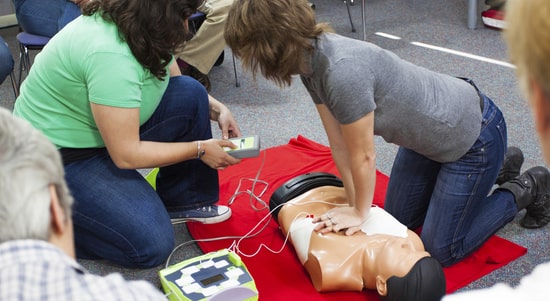
In-person first aid training centers vary in taste. A peaceful area session could fit twenty students with 2 teachers turning in between tables, each with handwear cover boxes, pocket masks, and training AEDs. A high-fidelity lab may include sensible moulage, timed circumstances, and debriefs that seem like a short fire academy. Either way, the responsive aspects matter.
You feel the breast recoil under your palms and listen to the click when you struck the right depth. You exercise rolling a bigger grownup right into the recovery position, not simply watching it in a video. You speak to an online "patient," pick up the hints in their voice, and learn to consistent your own. An excellent instructor sees the slump in your shoulders that means you are pushing with your arms instead of your hips, after that repairs it with one hint. Those details tighten up the skill loophole in a manner that on the internet training simply can not duplicate on its own.
This does not suggest the classroom is best. Conventional lecture blocks can drag. A room loaded with combined histories can lead to content that feels also progressed for some and as well fundamental for others. The very best teachers adapt on the fly, get into little teams, and instructor to skill, not seat time.
Time, expense, and comfort, without the shiny promises
Online or blended layouts normally win on scheduling. You can take the theory part in the evening, on a commute, or in twenty-minute chunks. If you work changes or CPR course near Salisbury have household duties, that flexibility is not a perk, it is the difference between training and never ever getting educated. Costs vary, but online-only choices frequently are available in less expensive per trainee since there is no room to lease and fewer staff hours. A mixed program, where you total theory online and then participate in a short skills session, still conserves time contrasted to a full-day class.
In-person courses request a block of time. For an extensive first aid and CPR course, expect four to eight hours, with added components if pediatric care or innovative bleeding control is consisted of. If your company collaborates an on-site course, that can flip the benefit formula. A well-run on-site brings the manikins to you, aligns situations with your environment, and decreases travel.
Beware of judging entirely on rate. Two CPR courses might both concern identified first aid certificates, yet one gives you 2 hours on comments manikins while the various other cycles thirty individuals with one manikin in 5 minutes each. People remember the cost, but when a colleague collapses, they will bear in mind exactly how it really felt to discover a chest rhythm and hold it for 2 minutes straight.
Skill retention and what really sticks
The skill degeneration curve for CPR is well documented. Without method, compression depth, price, and confidence erode within 3 to 6 months. That is why several service providers recommend a CPR correspondence course yearly, even if your certificate continues to be valid for two or three. Short booster sessions matter more than one long program every couple of years.
Online training aids with micro-refreshers. Ten-minute components on choking or AED pad positioning can be done quarterly. A fast interactive scenario over coffee can reset the psychological series: check responsiveness, phone call for aid, open respiratory tract, check breathing, start compressions, make use of AED. Where you need in-person time is the electric motor pattern. The initial min of compressions often looks great. By minute 2, numerous learners drift superficial or slow-moving. Just a manikin with responses, and a trainer standing over your shoulder, will fix that in actual time.
If I needed to divide a minimal allocate an office, I would fund an initial combined first aid and CPR course with at least 90 mins of hands-on manikin time each, after that schedule quarterly mini refresher courses on-line, and a short in-person abilities tune-up at the 1 year mark. That rhythm equilibriums theory, method, and the reality that teams neglect under anxiety if they do not rehearse.
Real-world situations where layout matters
I consider a store team that chose online-only training due to personnel turn over and organizing headaches. When a consumer fainted, the team did the primary study well. They called for aid quickly, managed the crowd, and put the client in the healing setting. All of that came straight out of the on-line modules and they performed easily. However when they faced a choking incident 2 months later on, the improvisated back blows were shy and the abdominal thrusts too high. An instructor would have taken care of both by literally leading hand placement and showing the difference between a mild rub and a strong strike angled upward. They did fix the choking, yet it took longer than it should have, and the group really felt shaken. They set up a skills session the following week and discovered how much responsive training helps.
On the opposite side, I collaborated with a producing site that trained in person once every three years and ignored refresher courses. Their first aiders were strong on the first day. A year later, in a drill, half the team neglected to switch on the AED before putting pads. Not a crisis in training, but a genuine delay in the wild. We added short on-line booster components and five-minute team gathers quarterly. The next drill ran crisp and fast. The mix of layouts solved a trouble that neither style alone had addressed.
Certification, compliance, and the great print
Regulatory structures drive several training decisions. Some sectors require accredited first aid courses with certain durations, material, and trainer qualifications. A healthcare setting might require grown-up, kid, and baby CPR training with AED, plus oxygen management and bag-mask air flow. Building sites often require specific blood loss control and immobilization content. Child care providers might need pediatric first aid and CPR that covers choking and injury prevention in age-specific detail.
Online theory can satisfy the expertise criterion. For the certification to satisfy an auditor or assessor, the program usually needs a recorded sensible evaluation. Many credible organizations use a first aid certificate just after you pass an in-person skills examine, also if you completed the lessons online. Do not think equivalence. If your workplace relies on a certification to meet legal duty-of-care standards, ask the company to map course elements to the regulation you should fulfill. A high quality company will gladly reveal that mapping.
If you are restoring, a CPR refresher Check out the post right here course might be much shorter, specifically if you can demonstrate capability swiftly on a comments manikin. On-line pre-work can reduce the class block. Still, anticipate to press to deepness, preserve rate, coordinate with ventilations if called for, and run the training AED smoothly.
The human variable: anxiousness, self-confidence, and teamwork
People freeze for foreseeable factors. They stress over doing damage. They feel subjected when others gather about. They struggle to entrust. Educating style influences those stressors.
Online environments are Provide First Aid Course Salisbury personal. Learners can pause and replay without shame. Quieter students usually prosper there, and their written evaluations show it. In person, however, the social aspect prepares you for a disorderly scene. You speak out to appoint someone to call a rescue and someone else to fetch the AED. You find out to claim "I am taking over compressions" out loud without apology. Those statements audio simple theoretically and really feel harder in the moment. Exercising with peers makes it simpler later.
I watch position as high as performance. The student who begins compressions with locked elbow joints however loose shoulders will tire. The one that waits to push securely since they fear breaking ribs requires a tranquil description that remedy compressions may break cartilage material, however superficial compressions trade comfort for failing. I have seen self-confidence rise visibly in a ninety-minute laboratory. Individuals leave standing taller, not since they aced a test, yet since their hands did the work and the manikin verified it.
Technology is enhancing, yet the floor still matters
Feedback manikins have raised bench. They report depth, price, recoil, and hands-off time, occasionally with a basic traffic signal, in some cases with numeric targets. Also budget-conscious programs now include at least a couple of of these tools. In online settings, app-enabled personal manikins and inflatable devices with sensing units exist, and they help home learners get closer to genuine practice.
Still, the floor matters. A soft mattress hides shallow compressions. Exercising on a stiff surface shows you to relocate your entire body, not simply your arms. Learning to bump a shoulder and yell to examine responsiveness, to tip the head and look for breathing for a maximum of ten secs, and to position pads around a bra band or upper body hair, these are nuances finest learned in a physical area. A trainer can replicate challenges you may deal with - limited restrooms, crowding, bad lighting - with chairs, cones, and tape. That improvisation is where class training gains its keep.
When online-first makes the most sense
There are instances where online-first training is the ideal call.
- You demand foundational knowledge quickly for a low-risk atmosphere and plan to add an in-person skills inspect later. Your team is dispersed and can not collect conveniently, however you can deliver AEDs and established staggered local analyses with companion instructors. Learners speak different mother tongues, and the online system supplies captions, stopping briefly, and rewinds that boost understanding. You are doing a CPR refresher course for people that recently had hands-on technique, and the objective is to reinforce sequence and decision-making. You want to maintain skills in between complete certifications with micro-scenarios and short quizzes.
In each of these, the on-line element amplifies access and retention. The caveat stays: for CPR and choking, timetable routine hands-on time with comments, even if brief.
When in-person is the smarter very first step
There are also clear signals that you should start personally. If your office hosts big groups, utilizes heavy tools, or has long EMS action times, you benefit from genuine technique. If your team shops an AED on site, they should experiment the training pads and device, not just enjoy a presentation. If you oversee youngsters or vulnerable adults, you require to really feel the distinction in between baby and adult compressions. If your group has never ever trained previously, the classroom builds a shared standard and lets a trainer appropriate common myths that linger online, like "I must look for a pulse prior to beginning compressions" when present ordinary rescuer standards focus on examining breathing and responsiveness.
Picking a service provider without obtaining lost in logos
Brand recognition helps, yet not all first aid courses are equal, even under the very same banner. Look past the brochure.
Ask how much specific manikin time each learner gets, and whether the manikins provide real-time comments on deepness and price. Inquire about instructor-to-student proportions. 10 learners to one instructor is practical, fifteen is pressing it unless there is a solid assistant. Verify whether circumstances mirror your real threats. If you function around forklifts, request realistic injury simulations. If your team staffs a fitness center, guarantee the CPR training consists of grown-up and youngster situations and AED pad positioning on sweaty skin.
If a carrier markets as First Aid Pro or a comparable name, treat it as a starting factor, not a coating. What matters is: do they adjust the first aid and CPR course to your setting, do they fulfill your regulatory requirement, and do they give a first aid certificate that your sector identifies? Good companies are transparent and will offer references from equivalent workplaces.
The price of doing it halfway
Partial training is common. A team does theory online and never schedules the abilities session. Or they do a one-off in-person day and after that skip refresher courses for years. The result is predictable. People remember just enough to be anxious, insufficient to be efficient. The antidote is not much more hours. It is a far better cadence.

Front-load responsive skills in year one. Maintain theory existing with short online modules in quarters two and 3. Do a fast in-person skills tune-up in quarter 4. Afterwards, preserve a pattern you can keep. A two-year cycle with at the very least one hands-on session annually will certainly maintain your CPR and first aid skills from fading to zero. The very same logic relates to a CPR refresher course; shorter, extra frequent touchpoints defeated a marathon every couple of years.
Remote and hybrid teams: practical means to bridge the gap
Distributed companies commonly stall because logistics seem intimidating. The workaround is a kit-based version. Ship tiny training manikins to regional champs, routine cohort-based online lessons with online trainers over video clip, and then run neighborhood skills checks in borrowed areas - a meeting room, a community hall, even a removed break location with a firm mat. Revolve equipment and capture sign-offs with photos and time stamps. It is not attractive, yet it meets criteria and develops experience with the actual AED version you have, not a generic image.
For families and caregivers, a recreation center can host month-to-month skills nights where people that completed an on the internet first aid course come for a one-hour hands-on session. The barrier to entrance stays reduced, the commitment stays short, and the community gains layers of capable responders.
The myth of best method vs good-enough action
Learners fret about failing a perfect requirement. They inquire about compression rates to the decimal and whether their hand should be one finger-width or 2 above the xiphoid. Accuracy issues in training, but in the wild, speed to very first compressions and continuous high quality trump small variants. I instructor individuals to chase after a target rhythm of regarding two compressions per 2nd, allow the chest completely recoil, and minimize stops. If you are within variety, you are doing extra great than you think.
Online tests can overemphasize trivial matters. Classroom drills can overstate showmanship. The sweet area is a functional state of mind: do what you can with what you have, start currently, and maintain going until aid takes control of or the person wakes or an AED encourages you to stop. A first aid and CPR course, whether online or face to face, must leave you with that said prejudice for action.
Pros and cons at a glimpse, without the fluff
Here is a succinct contrast to secure the decision.
- Online and combined strengths: flexible scheduling, scalable for huge or remote teams, economical theory distribution, exceptional for expertise refresher courses, easily accessible for multilingual learners. Online and mixed restrictions: minimal responsive mentoring without an abilities examine, variable acceptance for regulated roles, danger of easy discovering if web content is low quality. In-person strengths: hands-on mastery with feedback manikins, prompt coaching on stance and method, reasonable scenarios that build synergy and voice, greater self-confidence transfer under stress. In-person restrictions: scheduling and travel rubbing, higher per-seat price, quality varies by instructor-to-student ratio and equipment. Best happy medium: concept online plus a focused, top quality skills lab, after that short quarterly refreshers with an annual hands-on tune-up.
Making your decision with eyes open
Start with your "why." If your goal is to hold a legitimate first aid certificate for compliance only, a certified combined course is typically one of the most reliable course. If your goal is to shield a certain population - kids in a childcare, older grownups in a community center, lone employees in a warehouse in the evening - weight the hands-on element greatly and guarantee situations match your reality.
Look at your existing state. Has your group ever before touched your AED? Do employees understand where it is? Do they recognize just how to switch over from compressions to pads without stumbling? If the response is no, add an in-person block quickly. For homes, consider a compact in-person class every 2 years and supplement with on-line CPR training refresher courses for the whole family members. For athletic coaches, publication a CPR course that drills unexpected heart attack on the sideline with an AED you can lug at a jog.
Measure what you can. After training, run a five-minute drill once a quarter. Imitate a collapse, time to first compression, time to AED pads on breast, and time to very first shock. Tape it. Share outcomes. The act of gauging boosts efficiency, and it will certainly tell you when an on-line micro-module suffices and when you require to bring a trainer back in.
Final ideas from the training floor
Across thousands of sessions, one pattern keeps appearing. Individuals remember the moment their compressions hit the ideal depth and the responses light turned green. They bear in mind the first time they peeled AED pads and smoothed them onto a manikin while calling out "clear." They bear in mind the debrief where a teacher went through what worked out and what can be sharper, not as a scold but as an instructor. Those memories live in the muscle mass as high as the mind.
Online tools have made first aid training extra easily accessible and more consistent. In-person practice makes it real. A lot of groups do best with a blend: learn the why and the sequence online, then turn up and function the skills till they really feel natural. Maintain the cycle selecting brief refreshers, consisting of a CPR refresher course when your certification comes due or your drills start slipping.
If you commit to that tempo, it hardly matters whether your first session is on-line or in a classroom. What matters is that you begin, you practice, and when it counts, you act.